Tap-to-explore chart
Uluru at sunset: the color change explained
Light and weather
When the color show changes with the seasons
Pick a month to compare the sunset time and day length, then read what the weather usually does to the rock's colors that month.
Sunset
Jan
Heavy rain is most likely from November to March, the rare chance to see the rock wet.19
Feb
Lightning storms are still common into February.19
Apr
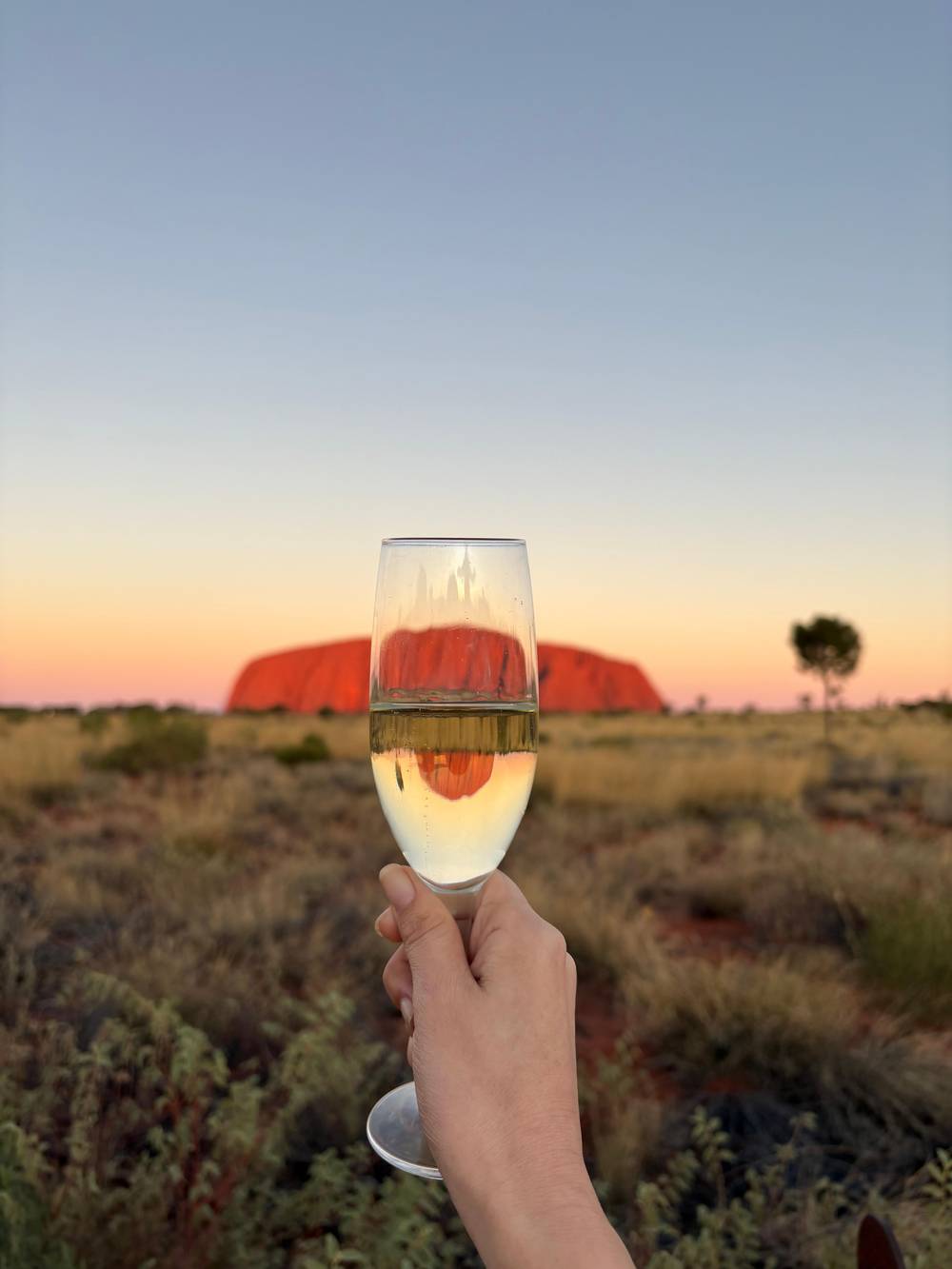
On a clear evening the rock moves from pink to deep red as the sun sinks.1
May
Very heavy downpours have also come in May.19
Jun
Mid-year can bring cloud, mist and morning frost.18
Jul
Clear, cold evenings; the purple stage lasts about 25 minutes.9
Aug
Among the driest months, with 6 mm of rain on average.40
Sep
Twilight ends around 7:02 pm on the 15th.9
Oct
The lightning season begins.19
Nov
Storm clouds bring lightning but often little rain.20
Dec
December averages 47 mm of rain, the wettest month at the station.40
Sunset is worked out for the 15th of each month on Central Australian time (UTC + 9.5, no daylight saving). Day length is for Uluru; temperatures and rainfall are NOAA averages for the Uluru Rangers station, 2.5 km from the rock, 1991 to 2020, on the ground.
Uluru at sunset seems to light up from inside, then fade through orange and red into a dusky purple. The show has a simple recipe: rusted iron in the rock, a low sun shining straight at it and a sky that filters the light.
Editorial team, ulurusunsettour.com · Updated November 8, 2026 · Read in 8 min
The essentials
The color sequence, minute by minute
Watching Uluru at sunset is a lesson in patience. From the car sunset viewing area, Parks Australia describes the rock moving from pinkish tones to a fluorescent orange and then into deep shades of red as the sun drops behind you.1 Ayers Rock Resort sums up the wider day the same way, with the rock passing from red to orange to a deep purple.2 The changes are gradual, so the best approach is to arrive early and simply watch.
The early part of the show happens while the sun is still above the horizon behind you. The rock warms first, then saturates. In the final minutes the face can look almost lit from within, and then the light lifts off the base and climbs the rock as the shadow of the horizon rises. Once the sun is gone the color drains quickly, leaving a darker red that slides toward purple and brown as the twilight fades.
The sky plays a part too. Behind and around the rock, Parks Australia notes pale blues and bright pinks at the car sunset area.7 On 15 July, for example, sunset comes at 6:13 pm and the last civil twilight at 6:38 pm, leaving under half an hour for the dusky purple phase.8,9 If you came for the Uluru sunset color change, stay until the very end.
Weather and color
What each kind of evening does to the rock
| Conditions | How the rock looks | When it happens |
|---|---|---|
| Clear and dry | Glowing red at sunset16 | May to September is coolest17 |
| Overcast | Moody16 | Mid-year clouds and mist18 |
| After heavy rain | Burgundy, silver or black5 | Most likely November to March19 |
| Storm season | Dramatic skies, lightning20 | October to February19 |
| Full moon | Moon rising beside the rock21 | At full moon |
From Parks Australia's photography, seasons and rain pages; rare conditions are never guaranteed.16,19
Why the rock is red at all
The color starts in the stone. Parks Australia explains that Uluru is arkose, a kind of sandstone, and that its surface is actually flaky red with gray patches.3 The red is iron in the rock that has rusted, while the gray is the original color of the stone, which you can still see inside many of its caves.3 What you watch at sunset is a thin skin of rust lit at a low angle.
That rusty skin is ancient. The rock began to form about 550 million years ago from a sandy fan of sediment that later became sandstone, while a rockier fan became the conglomerate of Kata Tjuta.11,12 Around 400 million years ago, as the sea retreated and the crust shifted, Uluru tilted 90 degrees while Kata Tjuta tilted only slightly.13 The visible rock is only the tip of a slab that continues underground for up to 6 km.14
Kata Tjuta behaves differently in the light. Its domes are built of rounded stones, much of it granite and basalt, glued together by sand and mud into what Parks Australia calls a plum-pudding mix.15 The surface is rougher and the color less uniform, which is part of why the domes at sunset read as a group of shapes and shadows rather than a single glowing block.
Rain and light by month
Rain, daylight and warmth at Uluru
- Jan10.4 h
- Feb11.0 h
- Mar11.7 h
- Apr12.5 h
- May13.1 h
- Jun13.4 h
- Jul13.3 h
- Aug12.8 h
- Sep12.1 h
- Oct11.4 h
- Nov10.7 h
- Dec10.3 h
Counts of sunless mid-month hours and of days with at least 2.5 mm of precipitation, from NOAA station Uluru Rangers, 1991 to 2020.40
Why the light turns it orange, red and purple
The sky does the rest. NASA explains that blue light is scattered more than other colors as sunlight passes through the air, which is why the sky looks blue.32 When the sun is low, its light crosses much more atmosphere to reach you; even more blue is scattered away and the reds and yellows pass straight through.4 At sunset Uluru is lit almost entirely by that warm, filtered light.
Dust can deepen the effect. NASA notes that small particles of dust or other aerosols also scatter blue light, which is why some sunsets look especially red.33 After a dry, windy day the desert air can carry more of it, and the light reaching the rock may look richer still. On a very clear winter evening the colors are cleaner and the purple phase after sunset is easier to see.
Placement matters as much as physics. The official sunset areas were sited so that evening rays strike the rock head-on, and that direct light is what produces the apparent change of color, Parks Australia explains.6 For a sun setting next to the rock rather than lighting it, Parks suggests heading to a dawn viewing spot in the evening.34
Choose your evening
Which color show suits you?
Read the wishes and pick the place or season that matches yours.
If I want the classic glowing photo
The car sunset area
The far end of its car park gives an uninterrupted line of sight.23
If I want both rocks in the frame
The bus area dune walk
Its far end looks over Uluru and Kata Tjuta together.31
If I want to see the rock wet
Come November to March
Heavy rain is most likely then.19
If I want the moon too
Time it for full moon
The moon is likely to rise beside the rock.21
If I want quiet and close-up color
Kantju Gorge
The sun hits the gorge directly at sunset.29
Cloud, rain and storm sunsets
No two evenings look the same. In Parks Australia's words, how the rock looks depends on viewing angle, weather and hour: it can seem brooding under overcast skies, glossy in the wet and red-hot at dusk.16 A thin layer of high cloud can catch pink light above the rock long after the base has gone dark, while a low bank on the western horizon can cut the show short.
Rain is the rare prize. A wet surface swaps the red for burgundy, silver or even black, each face with its own shade, and after a downpour waterfalls run off the rock.5,38 Ayers Rock Resort says only about 1% of visitors experience rain at the rock.39 The wettest spells tend to come from November through March.19 The rangers' station near the rock logs 47 mm in an average December and just 6 mm in August.40,40
Storms add their own drama. October to February is peak season for lightning, and strong dry winds often arrive first.19 Anangu describe the hottest season, usually late October to December, as a time of lightning from storm clouds that often fail to deliver rain.20 If a storm is building, watch from your vehicle or a shelter, and check the daily forecast posted at the Cultural Centre.41
Sunset tours
Price a color-change evening
Select a tour and party size to see where prices start.
Compare 3 side by side
Price a color-change evening
Select a tour and party size to see where prices start.
- Small-group sunset2 hours · for one person from $81
≈
View - Sunset and barbecue211 minutes · for one person from $230
≈
View - Sacred sites and sunset5 hours · for one person from $147
≈
View
Starting prices on GetYourGuide, exchanged at the ECB reference rate. The booking page gives the exact price.
A clear evening
The color change in stages
Late afternoon
Warm tones
The rock deepens as the sun lowers behind you.1
Final minutes
Fluorescent orange
The face glows before turning deep red.1
Sunset
Light lifts away
The sun's upper rim drops below the skyline.10
Twilight
Deep purple
The last stage of the day's colors.2
Last light
Dark silhouette
About 25 minutes after sunset in winter.9
Is Uluru purple at night?
Many people search for purple Uluru at sunset photos and wonder whether they are edited. The deep purple is real, but brief. It belongs to the minutes after the sun has gone, when the rock is no longer lit directly and is reflecting the sky's last glow. Ayers Rock Resort lists deep purple as the final stage of the day's color sequence.2
How long that lasts depends on the season. In mid-January civil twilight ends 26 minutes after sunset, and in June and July about 25 minutes after.9 After that, the rock becomes a dark shape against the stars. As the gates close each evening for everyone, a view of Uluru at night has to come from beyond the park boundary, around the resort.42,43
The full moon is the exception. From the car sunset viewing area, Parks Australia says a visit at full moon is likely to show the moon rising next to the rock around sunset.21 That gives you warm red on the rock and a cool silver disc in the same frame, and it is worth planning an evening around if your dates allow.
Video
Uluru, the red rock at the heart of Australia
SLICE Travel on YouTube · The video stays unloaded until you press play.
Uluṟu and Kata-Tjuṯa change colour and appearance depending on the angle, weather and time of day. The rock can appear moody on overcast days, shiny when it’s wet and glowing red at sunset.
For the best show
Color-change checklist
Where the color change looks best
The 2 Uluru sunset areas are separate car parks close to each other. The car area is for private vehicles only, while coaches use the nearby bus area, which anyone may enter before 4.00 pm.22,26,44 From the far end of the car park you get the clean, uninterrupted view, and the short dune walk from the bus area ends with Uluru on one side and Kata Tjuta on the other while the sun drops toward the domes.23,31 The dune path there is 500 m and takes 30 minutes return, and coach operators mostly bring drinks and snacks for the moment.25,27
For a quieter color change, walk to the rock itself. The setting sun shines directly into Kantju Gorge at the end of the Mala walk, turning its walls a fiery red against a vivid blue sky.29 It is a very different picture from the classic view, close enough to touch the shadows, and it is surprisingly quiet at that hour.30 The Mala walk to the gorge is 2 km return.28
At Kata Tjuta the domes move from pink through to a deep red while the sun sinks, seen from the sunset viewing area with its picnic tables.45 From the dune viewing area the light does not strike the domes directly, which can leave them dark and moody with strong contrast instead.46 Both are worth a second evening if your pass covers it; a park pass for an adult costs AUD 38 for 3 days.35
Photographing the change respectfully
The rock is sacred, and that shapes how you photograph it. At both car and coach viewing areas, please keep the whole rock in the frame and leave close-ups of its features alone.36 The north-east face, the side seen from the resort, is especially sensitive; Anangu ask for wide shots from a distance only.47,48 Drones are banned throughout the park.37
A tripod and patience pay off. Take a frame every few minutes from the same spot and you will capture the whole sequence, from pale pink to the final purple. Parks Australia suggests the end of the car park near the fence for the clearest line of sight, and advises arriving early for a good place.23 In school holidays the car area gets very busy, so allow extra time.49 Bring water, as the car park has none and no toilets either, and budget 15 to 20 minutes on the road from Yulara.24
Finally, keep your eyes on the sky as well as the rock. The color change on the stone is only half of what happens; behind you the western sky is going through its own sequence, and when the sun has gone the eastern sky over Uluru often holds a band of pink. Turning around once or twice is part of seeing the show properly.
FAQ
Brief questions, brief answers.
Why does Uluru change color at sunset?
What colors does Uluru turn?
What color is Uluru after rain?
Rainwater changes the surface color, and each side takes a different shade.5
How long does the purple stage last?
Civil twilight ends about 25 minutes after sunset in winter.9
Can I see the full moon rise beside the rock?
Parks Australia says you are likely to see it rise next to Uluru around sunset from the car area.21
Where is the best spot for the color change?
The official areas are placed so the sun hits the rock directly at sunset.6
Is Uluru gray inside?
The gray is the original rock color, visible inside many caves.3
Sources
- Parks Australia · Uluru car sunset viewing area ↩
- Ayers Rock Resort · Debunking your Red Centre travel myths ↩
- Parks Australia · Geology ↩
- NASA Space Place · Why is the sky blue? ↩
- Parks Australia · Rain on the rock ↩
- Parks Australia · Sunrise & sunset ↩
- Parks Australia · Uluru car sunset viewing area ↩
- U.S. Naval Observatory · Rise and set for the Sun for 2026, Uluru (E131 02, S25 21, zone 9.50h east of Greenwich) ↩
- U.S. Naval Observatory · Civil twilight for 2026, Uluru (E131 02, S25 21, zone 9.50h east of Greenwich) ↩
- U.S. Naval Observatory · Rise, set, and twilight definitions ↩
- Parks Australia · Geology ↩
- Parks Australia · Geology ↩
- Parks Australia · Geology ↩
- Parks Australia · Geology ↩
- Parks Australia · Geology ↩
- Parks Australia · Photography ↩
- Parks Australia · When to come ↩
- Parks Australia · Seasons ↩
- Parks Australia · Rain on the rock ↩
- Parks Australia · Seasons ↩
- Parks Australia · Uluru car sunset viewing area ↩
- Parks Australia · Uluru car sunset viewing area ↩
- Parks Australia · Uluru car sunset viewing area ↩
- Parks Australia · Uluru car sunset viewing area ↩
- Parks Australia · Uluru bus sunset viewing area ↩
- Parks Australia · Uluru bus sunset viewing area ↩
- Parks Australia · Uluru bus sunset viewing area ↩
- Parks Australia · Mala walk ↩
- Parks Australia · Mala walk ↩
- Parks Australia · Mala walk ↩
- Parks Australia · Uluru bus sunset viewing area ↩
- NASA Space Place · Why is the sky blue? ↩
- NASA Space Place · Why is the sky blue? ↩
- Parks Australia · Sunrise & sunset ↩
- Parks Australia · Buy your pass ↩
- Parks Australia · Uluru car sunset viewing area ↩
- Parks Australia · Photography ↩
- Parks Australia · Rain on the rock ↩
- Ayers Rock Resort · Debunking your Red Centre travel myths ↩
- NOAA · Global Summary of the Month, Station Uluru Rangers (NOAA GHCN ASN00015660), 1991 to 2020 ↩
- Parks Australia · Rain on the rock ↩
- Parks Australia · Opening hours ↩
- Parks Australia · Photography ↩
- Parks Australia · Frequently asked questions ↩
- Parks Australia · Kata Tjuta sunset viewing area ↩
- Parks Australia · Kata Tjuta dune viewing area ↩
- Parks Australia · Photography ↩
- Parks Australia · Photography ↩
- Parks Australia · Uluru car sunset viewing area ↩
More to read