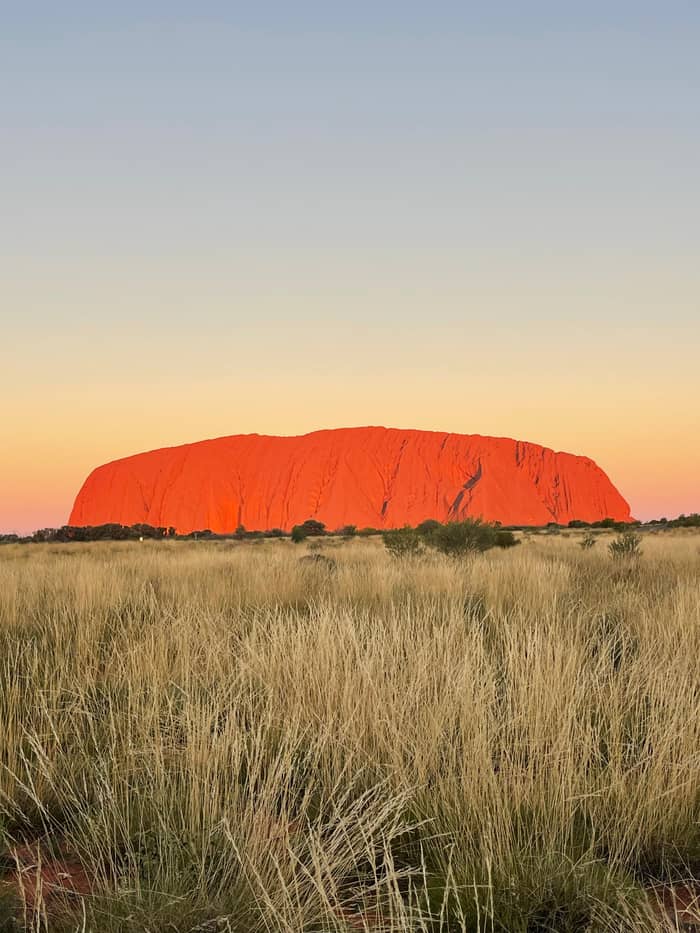
Layer up
Winter outfit
June to August
See sunset toursGuides
Language
Currency
See open datesfrom $147 · cancelling is freeTick-off checklist
Checklist: 8 items
Mark items as done. Your progress is saved on this device only.
0 / 8 ready
All ticked. Only the booking is left: your seat for the sunset.
Book your placeAn Uluru sunset in winter can start in sunshine and end near freezing, while a summer one starts in fierce heat with flies for company. Dress for the hour after the sun goes, not the hour before, and pack for the walk to the viewing spot.
Editorial team, ulurusunsettour.com · Updated November 8, 2026 · Read in 7 min
The essentials
The single most useful tip for a desert sunset is to dress for what happens next. Light fades fast: in mid-July civil twilight ends at 6:38 pm, about 25 minutes after a 6:13 pm sunset, and the air cools as the rock goes dark.7,8 At the rangers' weather station by the rock, a typical July night drops to 4.7 °C after a day of 20.2 °C.2 That swing is what catches people out on an Uluru sunset in winter.
Look at the leisure section of Parks Australia's packing list and the first entry is warm clothing for chilly nights and dawn starts, with a beanie and gloves added for winter.1 The hop-on hop-off operator puts it more bluntly: between May and September, mornings and evenings can be surprisingly cold, so bring layers even when the daytime forecast looks mild.9 The tours echo it, asking guests to bring a jacket or jumper in the cooler months.
Layers beat a single heavy coat. You will often walk in the afternoon sun, stand still at the viewing area as it cools, and sit on a coach or in a car on the way back. Thin underneath, warm in the middle and windproof on top is a combination that lets you adjust as you go, and they pack small enough to carry on the Kuniya or Mala walk before the sunset.
Layers by month
| Month | Average high | Average low | What to wear at sunset |
|---|---|---|---|
| January | 38.2 °C2 | 22.3 °C2 | Light long sleeves, hat, fly net |
| March | 34.1 °C2 | 18.4 °C2 | Light layers, hat |
| May | 24.3 °C2 | 9.1 °C2 | Long sleeves, light jacket |
| July | 20.2 °C2 | 4.7 °C2 | Warm layers, beanie, gloves |
| September | 28.8 °C2 | 11.2 °C2 | Long sleeves, light jacket |
| November | 34.2 °C2 | 18.2 °C2 | Light clothes, hat, fly net |
NOAA averages for the Uluru Rangers station, 1991 to 2020; clothing suggestions follow Parks Australia's packing list.2,1
The cool months are the comfortable season for sunsets, but the nights are properly cold. May to September is the season Parks Australia rates highest, with afternoons mostly between 20°C and 30°C, though it cautions that winter nights get very cold.11,12 It also records winter overnight temperatures as low as -7°C in the park.13 In Anangu terms this is Wari, roughly the end of May to July, when some dawns bring frost or dew.14
Long-term figures from the rangers' weather station near the rock show the pattern. June averages a high of 20.7 °C and a low of 6.5 °C, July 20.2 °C and 4.7 °C, and August 23.6 °C and 6.6 °C.2,2,2 A sunset in those months is pleasant at the start and chilly by the end, especially with the breeze that often picks up across the dunes.
For an Uluru sunset in May, the evenings are milder but still cool. May averages a high of 24.3 °C and a low of 9.1 °C at the station, and Anangu describe April and May as the start of the cold weather.2,15 A long-sleeved top and a light jacket are usually enough at sunset in May, with a warmer layer in the bag for the ride home.
Heat and cold
Counts of sunless mid-month hours and of days with at least 2.5 mm of precipitation, from NOAA station Uluru Rangers, 1991 to 2020.2
An Uluru sunset in summer is a different challenge. Parks Australia says the park often hits 30°C or more, with some summer days above 40°C, and that October to March regularly sees days above 35°C.19,20 January afternoons at the rangers' station average 38.2 °C and its nights 22.3 °C; December runs 35.8 °C and 20.1 °C.2,2
Even at sunset the heat lingers, so dress light and cover up. Parks Australia's packing list recommends long, lightweight clothing for protection from both sun and insects, along with a broad-brimmed hat, sunglasses and sunscreen.3,5 Loose, light-colored cotton or linen works well. Skip dark synthetic fabrics that hold the heat of the afternoon. In summer, Parks Australia asks walkers to finish by 11.00 am and to keep drinking water.17
Summer also brings flies in large numbers, and Parks Australia's answer is a protective head net, available to buy on arrival.16 The hop-on hop-off operator gives the same advice for summer: dress sun smart and consider a fly net.21 A head net looks odd in photos, but it lets you enjoy the colors in peace; lift it off for the photo and put it back on straight after.
Pack for you
Find your travel month or worry and see what to add to the bag.
If I travel in July
Beanie, gloves, warm layers
Parks Australia lists them for winter nights.1
If I travel in January
Fly net and long light sleeves
Flies are numerous in summer and sun protection matters.16,3
If I hate being cold
A windproof shell
The air cools fast after the 6:13 pm July sunset.8
If I will do the walks
Sturdy shoes and water
If Rain is forecast
Jacket and closed shoes
The temperature can drop dramatically in heavy rain.18
Outfits by season
Layer up
June to August
See sunset tours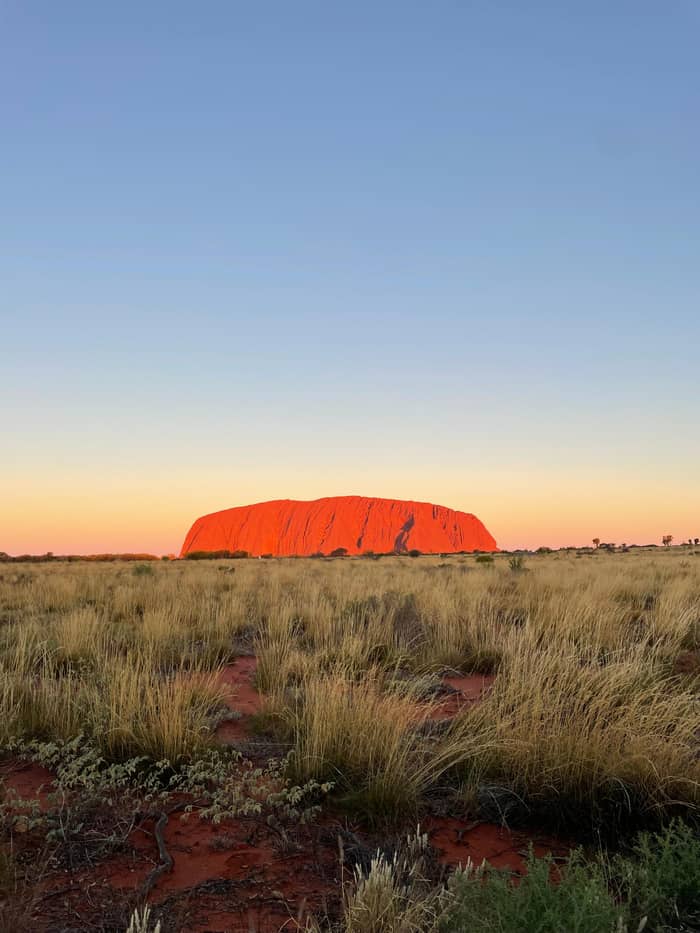
Cover up light
December to February
See sunset tours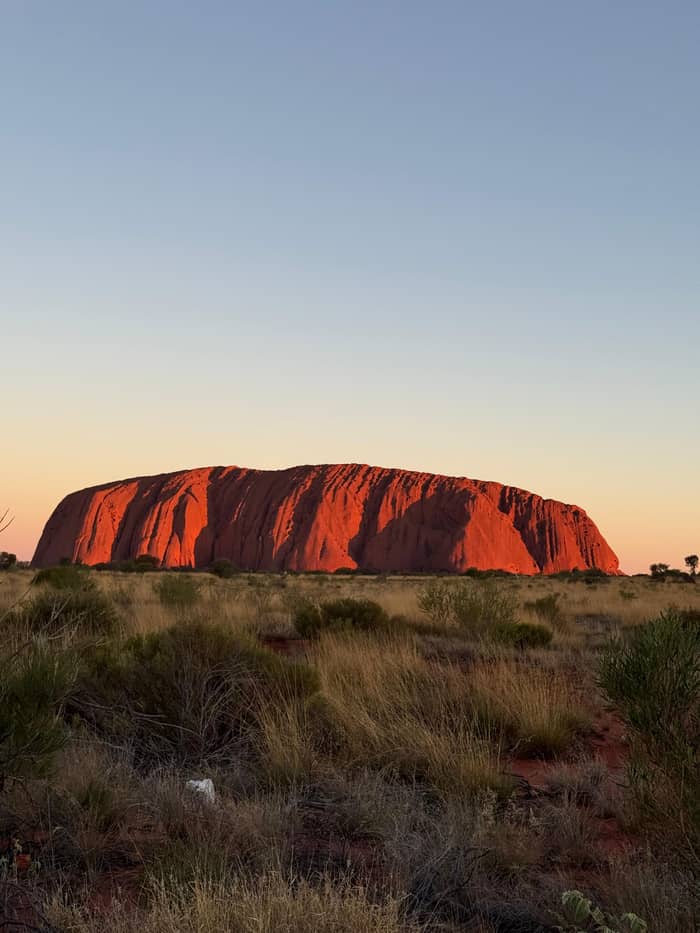
Easy layers
May, September, October
See sunset toursMost sunset tours include a short walk before the light show. The tour sold on this site asks guests to wear comfortable walking shoes and to carry no less than 1 liter of water. The Kuniya walk to Mutitjulu Waterhole is 1 km return on a grade 2 track, and the Mala walk to Kantju Gorge is 2 km return.23,24 Sandals slip on sandy, rocky paths; closed shoes with grip are better.
Parks Australia's staying-safe advice puts it simply: put on sunscreen, a wide-brimmed hat and solid walking shoes.5 The day tour with a sunset barbecue goes further and lists a 1-liter water bottle, non-slip shoes, a hat, a flynet, sunglasses and sunscreen, with warm clothing recommended in winter. It is a good template for any afternoon-to-evening outing at the rock.
Dress modestly and quietly at the sacred places. There is no formal dress code, but these are places of deep cultural importance, and simple, practical clothes suit them. Keep to marked tracks, which Parks Australia says is the way to avoid entering sacred areas by accident.25
Sunset tours
Choose a tour and group size for a from-price.
Compare 3 side by side
Choose a tour and group size for a from-price.
≈
View≈
View≈
ViewStarting prices on GetYourGuide, exchanged at the ECB reference rate. The booking page gives the exact price.
Water matters as much as clothing. Each walker should carry and drink a liter or more every hour, Parks Australia says, while skipping sports drinks, diet cordial and anything with caffeine, all of which can worsen dehydration.6,26 An insulated bottle keeps water cool through a warm afternoon and doubles as a hand warmer filled with tea on a winter evening.
Timing is part of dressing for the heat. The park's heat rule of thumb: stay off the tracks in the hottest stretch, which runs 2.30 pm to 6.30 pm, while in summer nothing on foot after 11.00 am.27 In the hot months that means keeping walks for the morning and treating the sunset as a time to sit, not to hike. The sunset tours' short walks happen in the late afternoon, so pick a light, breathable outfit.
Know the warning signs. Parks Australia lists heat exhaustion, dehydration and hyponatremia as real dangers in the park.19 If someone in your group feels dizzy or nauseous, get them into shade, cool them down and seek help; emergency services are on 000, or 112 from mobiles.28
Video
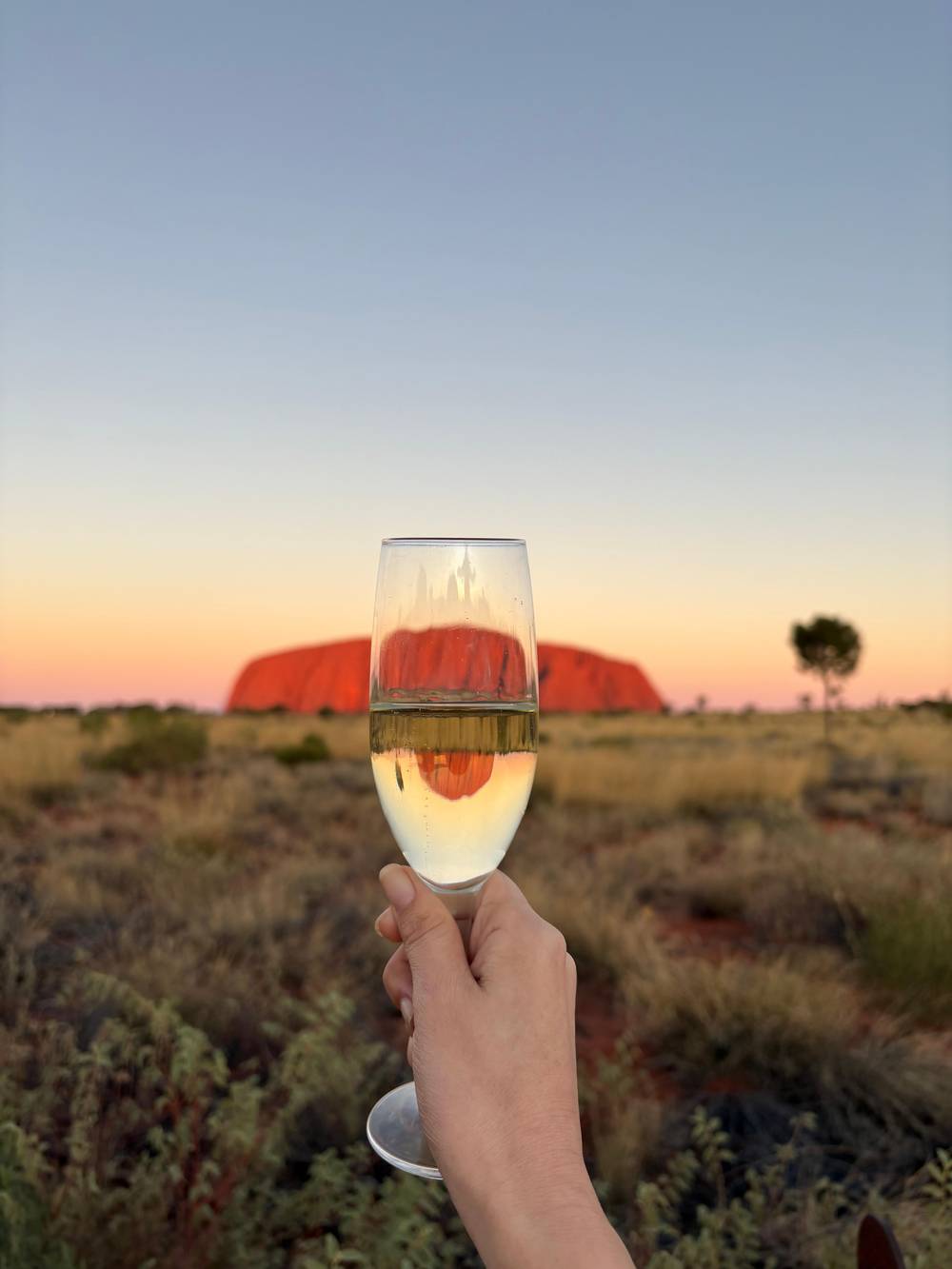
Next Life Caravan Adventures on YouTube · The video stays unloaded until you press play.
Overnight temperatures can be very cold during winter, so be sure to bring some warm clothing with you.
Rain is rare, but when it comes it changes everything. Parks Australia says the temperature can drop dramatically during heavy rain, and advises a sweater or jacket and sturdy closed-toe shoes, since tracks get very muddy and snakes and centipedes may come out.18,29 Many tour operators provide umbrellas and ponchos, and rain gear can be bought in the Yulara town center.30
Storms bring their own chill. Anangu note that the wind rises and the air cools roughly ten minutes ahead of a storm.31 Downpours cluster from November to March, while lightning peaks between October and February.32 A light waterproof shell covers both the shower and the wind, and folds into a day bag.
Check the forecast on the day. Parks Australia says the daily forecast is posted at the Cultural Centre.33 If rain does fall, take the chance to see the rock wet: Parks Australia describes colors from dark burgundy to shining silver and even black, and waterfalls on the rock.34
A few small items earn their place in the bag. Parks Australia's walking list includes sunglasses, lip balm, binoculars, a camera and insect repellent, and the camping list a head torch.35,36,22 A torch is useful on any sunset outing: the walk from the car or coach back to your seat happens in near darkness on a winter evening.
Think about your hands and head too. A beanie and gloves sound excessive for a desert, but Parks Australia lists them for winter, and they matter when you stand still on a dune at dusk.1 A scarf or buff blocks wind and dust and works as a light sun shield earlier in the day.
Finally, keep the camera ready but light. Parks Australia asks photographers to capture the whole rock from the sunset areas rather than zooming into details, which suits a small camera or phone as well as a big lens.37 Leave any drone at home: the whole park bans them.38
FAQ
At the rangers' station, July days average 20.2 °C and nights 4.7 °C.2
Flies swarm in summer, and a head net can be bought on arrival.16
The tour asks for comfortable walking shoes, and Parks Australia advises sturdy ones.5
Parks Australia advises at least a liter per person per hour when walking.6
Parks Australia records winter overnight temperatures as low as -7°C.13
Stay on marked tracks to avoid entering sacred areas.25
Sources
More to read
Planning an evening at Uluru? A real person answers here.